Mission 2 · The story
Dror says: That way.
Drag the brain to turn it. Pinch to zoom.
Neurons from the MaleCNS v1.0 (opens in a new tab) connectome by HHMI Janelia FlyEM (opens in a new tab), the University of Cambridge (opens in a new tab), the MRC Laboratory of Molecular Biology (opens in a new tab), and Google Research (opens in a new tab), under CC BY 4.0 (opens in a new tab).
Fly: NeuroMechFly v2 (opens in a new tab) (EPFL), Apache-2.0
About this lessonWiredMind · Lesson 2
Three-dimensional view of the neurons. Drag to turn it. Pinch to zoom.
Loading the circuit…
Push a real fruit fly’s internal compass around, then silence the ring neurons and watch its sense of direction drift. A free 10-minute lesson.
Tap Stimulate to fire the left turn neurons (the turning signal). Then watch the compass dial.
The compass neurons (the heading cells) light up on one side. That bright patch, the bump, marks which way the fly faces.
Now tap Stimulate on the right turn neurons (the other signal). Keep your eyes on the bump.
The bump swung around the dial. Turning signals from each side push it opposite ways, so the fly’s sense of direction turns too.
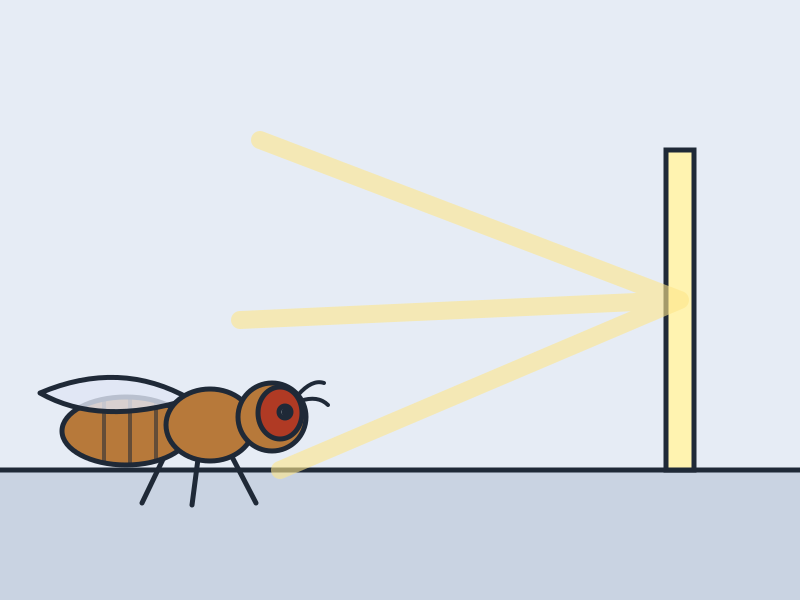
Silence the ring neurons (the landmark carriers). They bring in what the fly sees. We will fire the right turning signal for you.
The bump slips off its spot and wanders. Without landmarks, the compass drifts.
Tap the ring neurons (the landmark carriers) button again to switch them back on. We will send the same turning signal.
The bump holds its spot again. Landmarks keep the fly’s compass true.